-
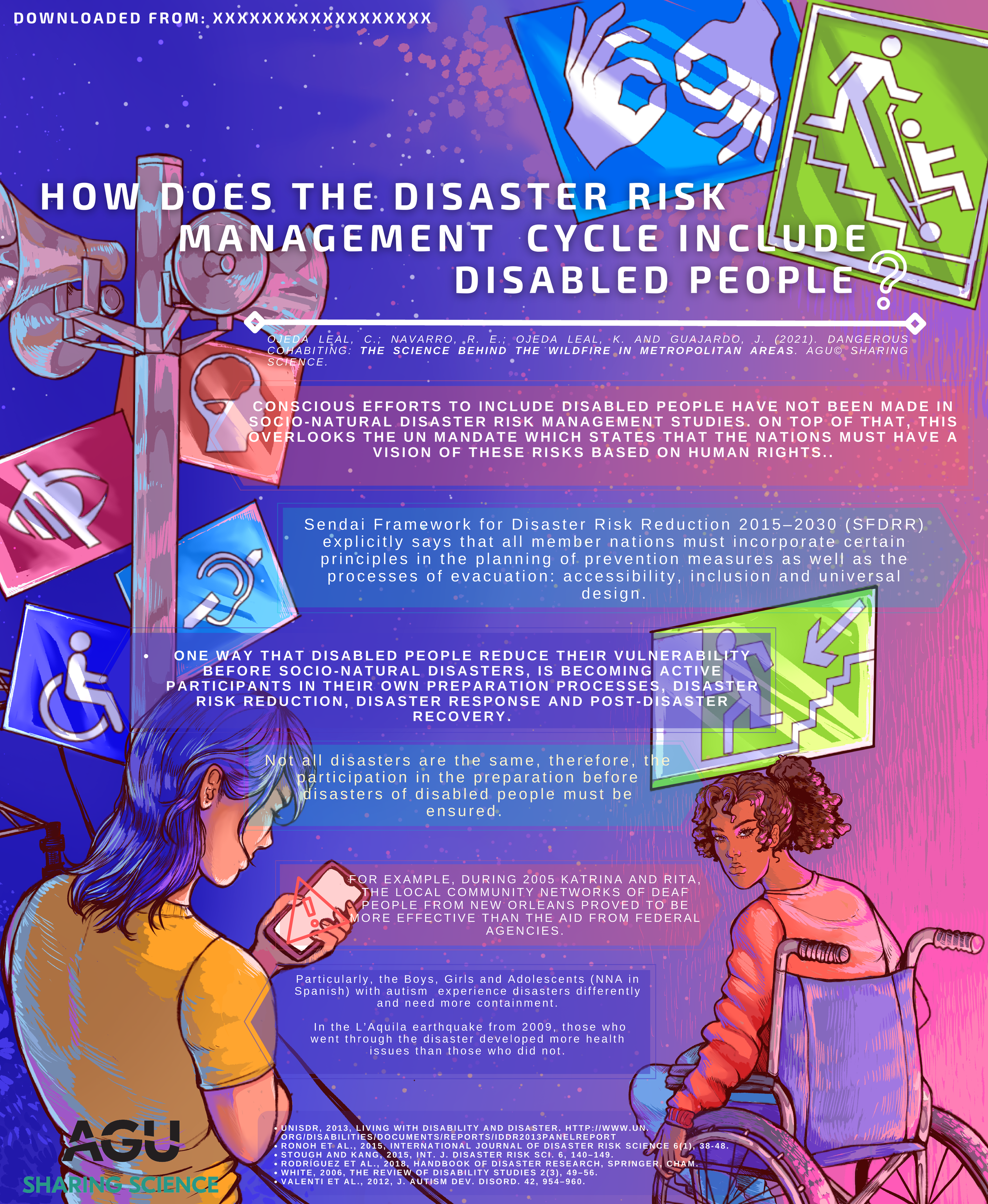
Conscious efforts to include (disabled) people with different abilities have not been made in socio-natural disaster risk management studies. On top of that, this overlooks the UN mandate which states that the nations must have a vision of these risks based on human rights.
-
Sendai Framework for Disaster Risk Reduction 2015-2030 (SFDRR) explicitly says that all member nations must incorporate certain principles in the planning of prevention measures as well as the processes of evacuation: accessibility, inclusion and universal design.
-
One way that (disabled) people with different abilities reduce their vulnerability before socio-natural disasters, is becoming active participants in their own preparation processes, disaster risk reduction, disaster response and post-disaster recovery.
-
Not all disasters are the same, therefore, the participation in the preparation before disasters of (disabled) people with different abilities must be ensured. For example, during 2005 Katrina and Rita, the local community networks of deaf people from New Orleans proved to be more effective than the aid from federal agencies.
-
Particularly, the Boys, Girls and Adolescents (NNA in Spanish) with autism (TEA in Spanish) experience disasters differently and need more containment. In the L’Aquila earthquake from 2009, those who went through the disaster developed more health issues than those who did not.
References
- UNISDR, 2013, Living with disability and disaster. http://www.Un.org/disabilities/documents/reports/iddr2013panelreport
- Ronoh et al., 2015, International Journal of Disaster Risk Science 6(1), 38-48.
- Stough and Kang, 2015, Int. J. Disaster Risk Sci. 6, 140-149.
- Rodríguez et al., 2018, Handbook of Disaster Research, Springer, Cham.
- White, 2006, The Review of Disability Studies 2(3), 49-56.
- Valenti et al., 2012, J. Autism Dev. Disord. 42, 954-960.
Download
Download this infographic as PDF: PG3.pdf