-
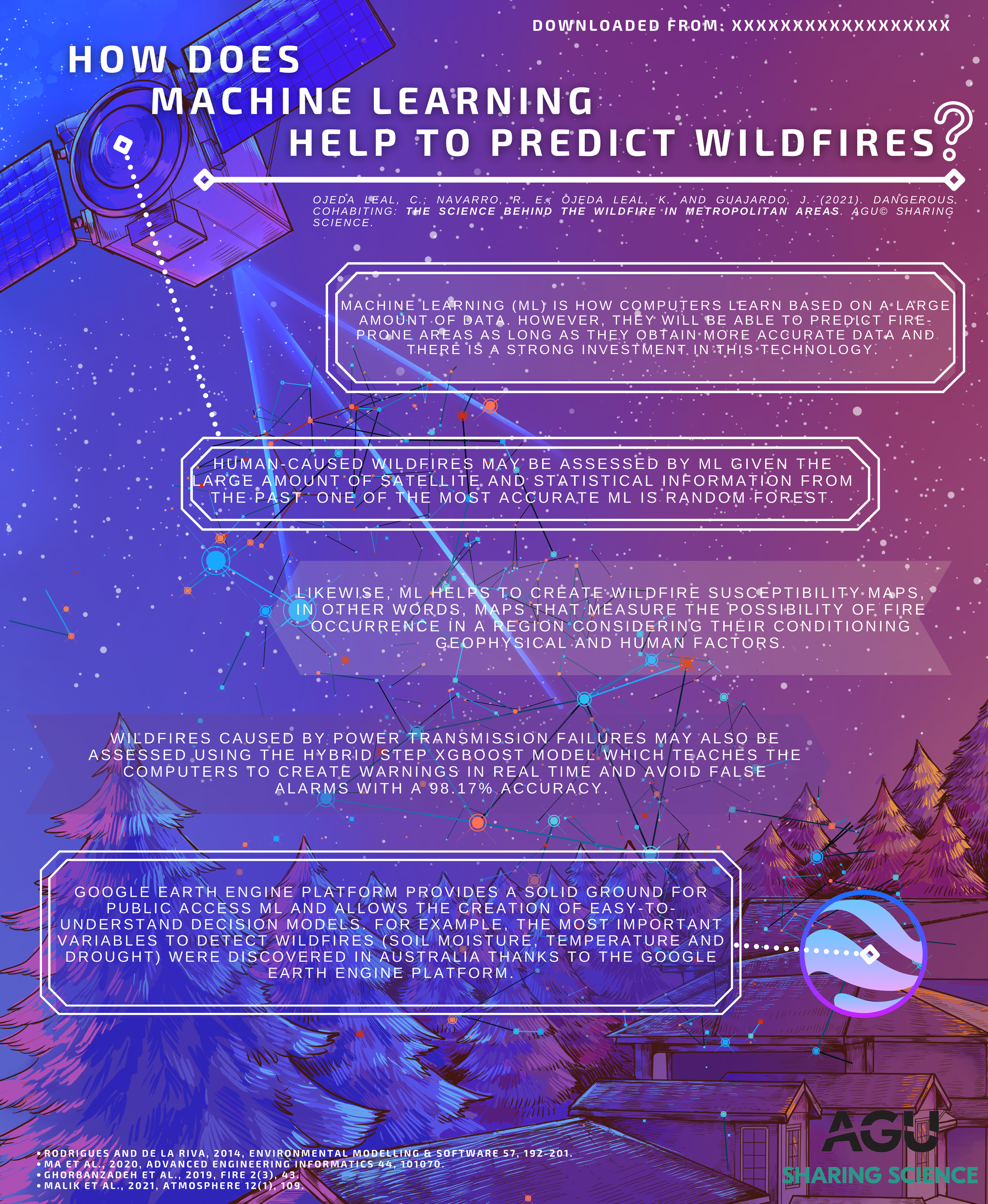
Machine Learning (ML) is how computers learn based on a large amount of data. However, they will be able to predict fire-prone areas as long as they obtain more accurate data and there is a strong investment in this technology.
-
Human-caused wildfires may be assessed by ML given the large amount of satellite and statistical information from the past. One of the most accurate ML is Random Forest.
-
Wildfires caused by power transmission failures may also be assessed using the Hybrid Step XGBoost model which teaches the computers to create warnings in real time and avoid false alarms with a 98.17% accuracy.
-
Likewise, ML helps to create wildfire susceptibility maps, in other words, maps that measure the possibility of fire occurrence in a region considering their conditioning geophysical and human factors.
-
Google Earth Engine platform provides a solid ground for public access ML and allows the creation of easy-to-understand decision models. For example, the most important variables to detect wildfires (soil moisture, temperature and drought) were discovered in Australia thanks to the Google Earth Engine platform.
-
The ML based on data that combine satellite observations and temporary statistics obtain better accuracy percentages (between 80 and 95%). Since the data are more reliable, professionals capable of understanding these processes in fire-prone areas will be needed.
References
- Rodrigues and de la Riva, 2014, Environmental Modelling & Software 57, 192-201.
- Ma et al., 2020, Advanced Engineering Informatics 44, 101070.
- Ghorbanzadeh et al., 2019, Fire 2(3), 43.
- Malik et al., 2021, Atmosphere 12(1), 109.
Download
Download this infographic as PDF: PG5.pdf